Gas-phase chemistry
The formation of photo-oxidants – particularly ozone – in what is known as ‘photochemical smog’ (also called ‘summer smog’) is one of the biggest environmental policy issues in summer. Photochemical smog forms when three main conditions are met: increased emissions of volatile organic compounds (VOCs), increased emissions of nitrogen oxides (NOx = NO + NO₂) and intense solar radiation. Meteorological factors also play a major role. Ozone formation in this system results from highly complex, sunlight-driven gas-phase reactions involving VOCs in the presence of NOx.
To explain the development of a ‘photosmog’ situation, the interactions between a large number of chemical, physical and meteorological processes must be taken into account. Computer simulations (model calculations) are an important tool in this regard and can provide the information needed to inform environmental policy decisions. However, the success of such simulation calculations depends on having as accurate an understanding as possible of the oxidative degradation mechanisms of volatile hydrocarbons in the troposphere, which are largely determined by photolysis and radical reactions in the gas phase. Oxidative degradation processes are initiated by radicals and reactive molecules such as the hydroxyl radical (OH), ozone (O₃) and the nitrate radical (NO₃), with most oxidation processes occurring via OH radicals.
Large-volume simulation chambers enable the investigation of individual reactions and complex reaction pathways that are significant in the atmosphere. Since the late 1970s, the Department of Physical Chemistry in Wuppertal has been investigating the chemical and physical properties of volatile organic compounds in the gas phase.
Reaction chambers with volumes ranging from 0.42 m³ to 1.08 m³ (see figure) are generally used for the experiments. The compounds under investigation are analysed in the reaction chambers using highly sensitive analytical methods (e.g. long-path FTIR and UV spectrometry, GC-FID, GC-MS). In addition to measuring the IR and UV absorption cross-sections, the photolysis rates and the rate constants of the reactions of these compounds with OH radicals, ozone and NO₃ radicals are determined. Furthermore, the products of these reactions are quantified so that a degradation mechanism for the compounds that is as complete as possible can be established.
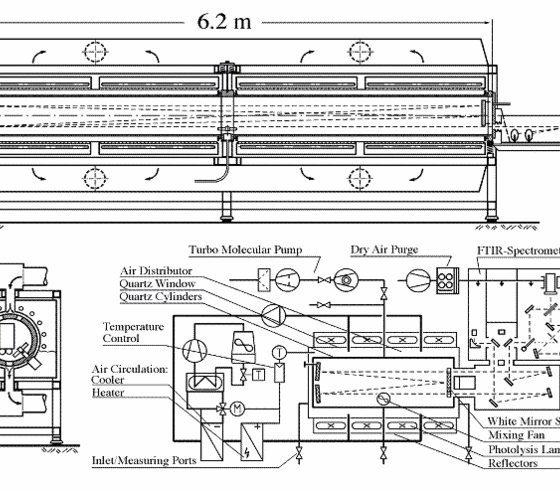
Schematischer Aufbau des 1080 l-Quarzglasreaktors
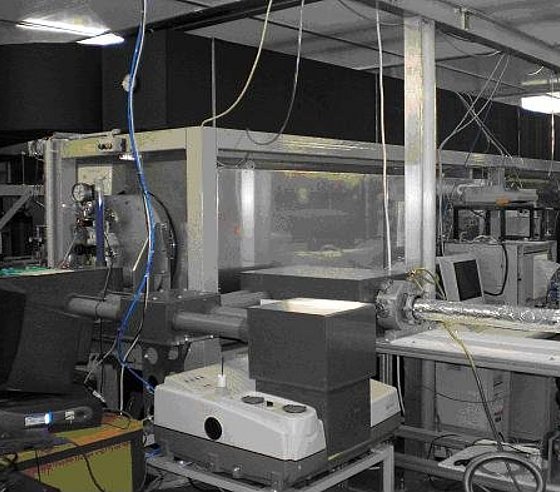
Foto des oben schematisch dargestellten Reaktors; im Vordergrund sind das FTIR-Spektrometer sowie die Transferoptik zu erkennen