LOPAP (Long-Path Absorption Photometer) measuring instruments
In this method, trace substances are converted into dyes in solution through selective chemical reactions and are then detected with high sensitivity using long-path absorption in a so-called ‘liquid core waveguide’.
In the development of the instruments, particular emphasis is placed on avoiding cross-sensitivity to other trace substances (interference).
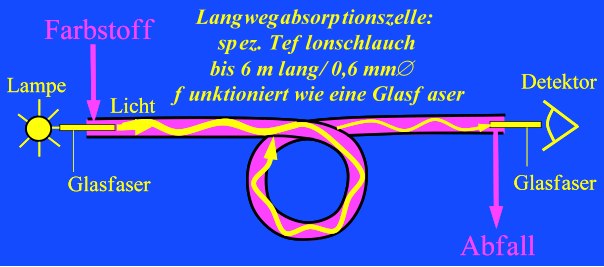
Funktionsprinzip eines „Liquid Core Waveguide“
LOPAP measuring instruments developed to date:
- Development of the world’s most sensitive analyser for the detection of nitrous acid (HONO), with a detection limit of 0.2 ppt (1 ppt corresponds to one particle in 10¹² = 1,000,000,000,000 air particles)
- Development of a highly sensitive HNO₃ measuring instrument (detection limit approx. 2 pptV)
- Development of a highly sensitive NO₂ measuring instrument (detection limit approx. 1 pptV)
- Development of a combined analyser for the simultaneous detection of O₃ and NO₂
- Development of a ‘Relaxed-Eddy-Accumulation’ (REA) measuring instrument for quantifying nitrous acid (HONO) fluxes over ground surfaces
- Development of a sensitive analyser for the selective detection of ammonia (NH₃) in the atmosphere (ongoing project)
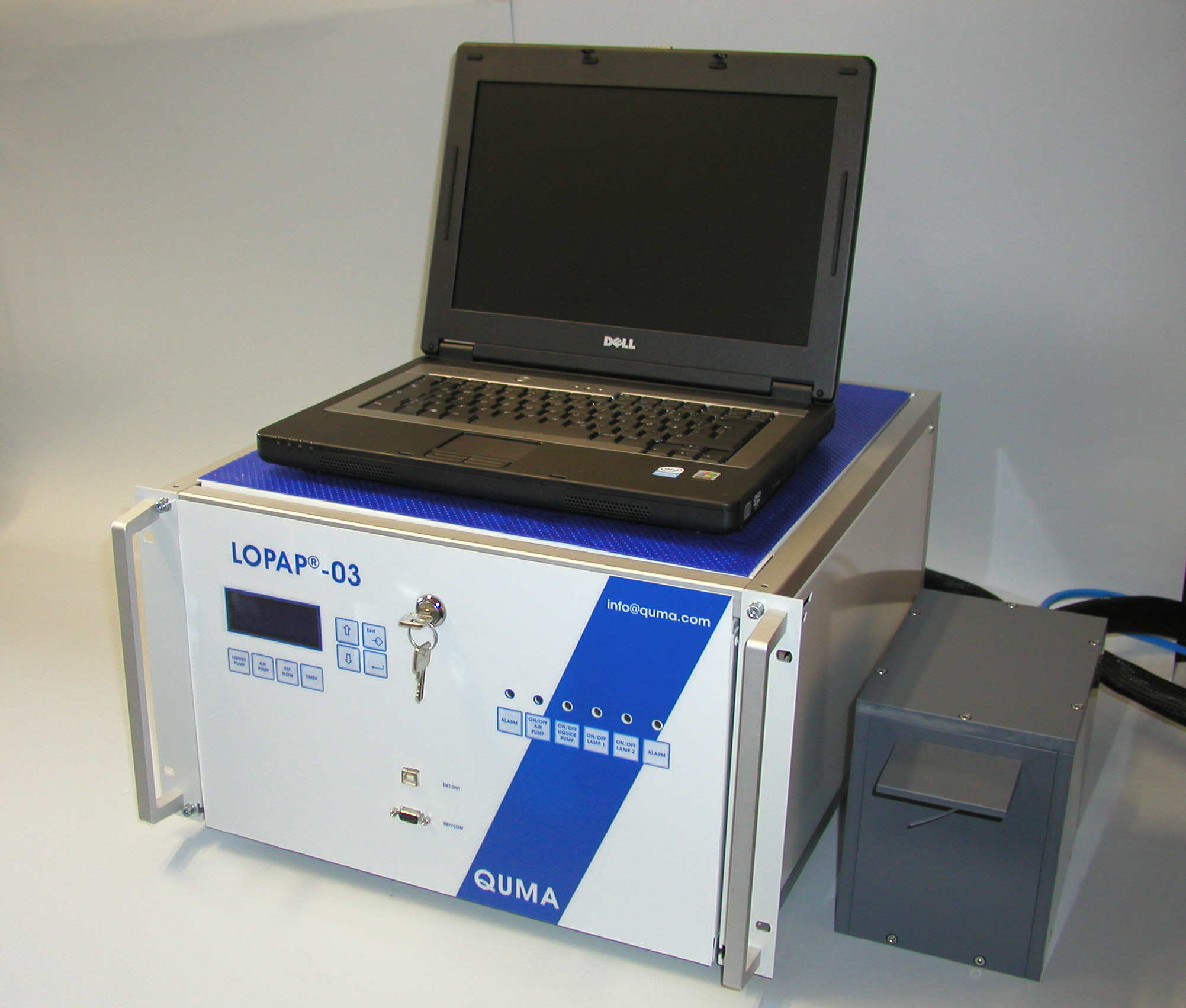
LOPAP-Messgerät zum Nachweis von salpetriger Säure