Atmospheric chemistry
Atmospheric chemical processes are of great importance for life on Earth, as they have a decisive influence on air quality and quality of life. For example, light-induced chemical reactions are responsible for the formation of photooxidants such as ozone in what is known as ‘summer smog’. These light-induced reactions produce so-called ‘radicals’, which break down pollutants in the atmosphere. The OH radical, considered the most important of these, is therefore also referred to as the atmosphere’s ‘detergent’. Given the great importance of OH radicals, a key focus of Physical Chemistry (PC) in Wuppertal is the identification and quantification of new sources of OH radicals. Further examples of important atmospheric chemical processes include the ozone hole and acid rain, both of which are caused by heterogeneous chemical processes.
Key tools used in atmospheric chemistry research in Wuppertal include laboratory studies, field measurements, emissions measurements, Method development and modelling and their interrelationships. In laboratory studies, atmospheric reactions are investigated under controlled conditions, and the findings serve as the basis for field measurements and modelling. In the field measurements, in turn, the aim is to track complex processes and then describe them using the models. If this is successful, the models enable a certain degree of prediction of future atmospheric conditions, and, based on the findings, recommendations can be made – for example, regarding emission reductions – which can then be verified using emission measurements. For measurements in the laboratory and in the field, highly sensitive measuring instruments are still required, some of which are developed in-house at the PC (see Method Development). It is important that these instruments are closely integrated, as, for example, the development of new, sensitive measuring instruments can lead to unexpected observations in field measurements, which in turn can trigger new laboratory and modelling studies. An example of the successful integration of the instruments mentioned above is the ozone hole, which was initially observed unexpectedly in field measurements, which led to the discovery of new reactions in the laboratory and, following successful modelling of the processes, ultimately resulted in the reduction of emissions of the chlorofluorocarbons involved.
Interdisciplinary atmospheric research
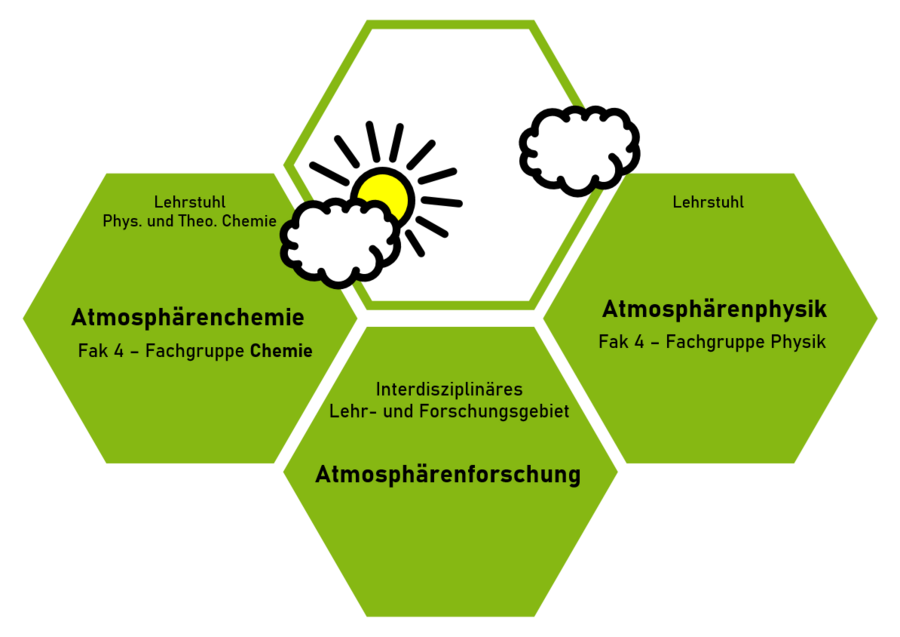
At the University of Wuppertal, one finds a constellation of research fields relating to the atmosphere that is unique in North Rhine-Westphalia: on the one hand, within the Department of Chemistry, the Atmospheric Chemistry Research Group, which operates under the Chair of Physical and Theoretical Chemistry; and on the other hand, the Chair of Atmospheric Physics within the Department of Physics. The collaboration between these two chairs gives rise to the interdisciplinary field of atmospheric research.
Atmospheric research forms part of the Interdisciplinary Centre for Atmosphere and Environment (IZAU), which, in addition to atmospheric issues, also addresses other environmental aspects such as soil, water, transport, safety, economics, etc.
Atmospheric Chemistry in the degree programme:
In addition, the Chemistry Department has a research focus on molecular environmental chemistry; this is also included in the compulsory-elective module of the Master of Science (Chemistry) . A whole range of chairs from the Department of Chemistry and Biology are involved in this area:
- Analytical Chemistry (detection of trace substances in air and water, water chemistry)
- Inorganic Chemistry (chemistry of halogen oxides)
- Physical Chemistry (laboratory and field measurements relating to atmospheric chemistry)
- Theoretical Chemistry (calculation of critical molecular structures)
- Microbiology (biological degradation of trace substances)