Heterogeneous chemistry
Heterogeneous chemistry deals with processes involving different phases. It examines, for example, reactions of gases in liquids (following a phase transition) or reactions of gases on solid surfaces. Since the 1980s, heterogeneous chemistry has become increasingly important in relation to the atmosphere, as the so-called ‘ozone hole’, for example, could only be explained by means of heterogeneous reactions. Another important example of heterogeneous processes in the atmosphere is ‘acid rain’, which is caused, amongst other things, by the absorption of sulphur dioxide (SO₂) and reactive nitrogen compounds (NOy) into water droplets and the subsequent chemical reactions in the liquid phase.
In the Department of Physical Chemistry in Wuppertal, heterogeneous processes have been studied for around 15 years. Some examples are listed below:
- Heterogeneous transformation of reactive nitrogen compounds (NOy) on soot surfaces, airborne organic particles and liquid surfaces
- Solubility of gaseous trace substances (e.g. HONO, HBr, HCl and HNO₃) in liquids (e.g. water, ammonium sulphate solutions, binary and ternary acid mixtures), including at stratospheric temperatures
- Heterogeneous formation of nitrous acid (HONO) in smog chambers to characterise the so-called ‘background reactivity’ in these chambers
- Adsorption of nitrous acid (HONO) onto plant surfaces
- Photochemical formation of nitrous acid (HONO) on organic substrates (e.g. humic substances)
- Photocatalytic conversion of pollutants on titanium dioxide (TiO₂) surfaces.
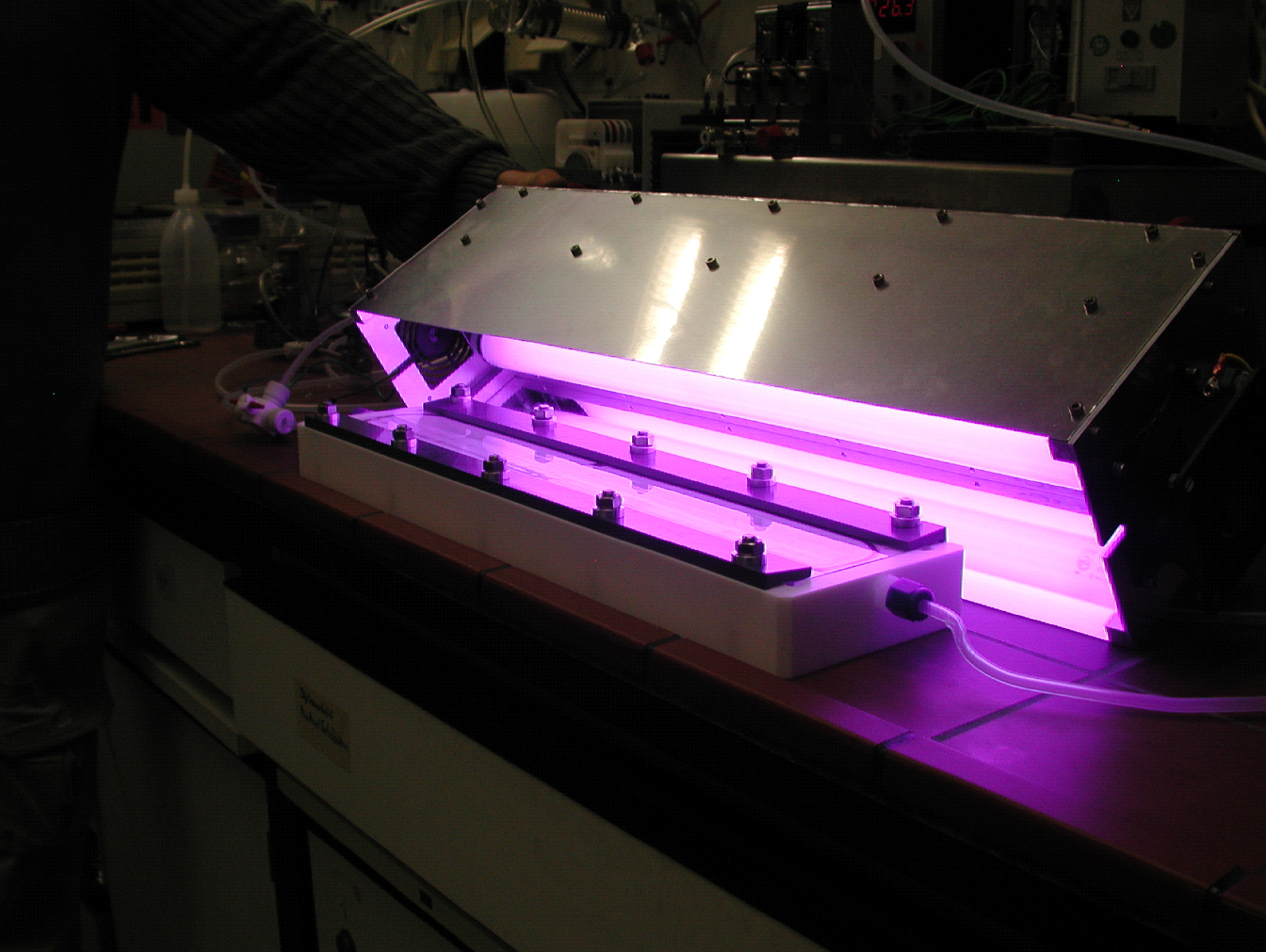
Photoflussreaktor in der Physikalischen Chemie zur Untersuchung heterogener Reaktionen an Photokatalysatoren